Blowing my own vuvuzela since 2006

4 Jul 2010

Warm welcomes

Leaving a very pleasant evening drinks party at some friends in Molember Road, a small cul-de-sac in East Molesey, Mrs Botogol and I were nonplussed to find that an angry note had been placed on our car windscreen.


Isn't that friendly?  I love the way that the anonymous writer acknowledges that the owners of the car will be there by invitation to visit a resident of the road, and therefore not trespassing... under the heading 'Trespass'. 


We stood in the road and read the note and looked around at the smart houses. Presumably in one of the darkened windows above us an angry resident was stood behind a curtain watching us. I waved.


When we got home I googled the Molember Road Residents Association. They are a shadowy lot, with no web page, and have troubled google's index robots only once: in a dispute about a proposal to build a mobile phone mast.  What's that?  No, no, they weren't campaigning against the phone mast: they were trying to build one in the next road along.


So there you have it. The Molember Road Residents Association. Key activities

  • harassing each other's visitors
  • despoiling other people's roads
In this day and age I think it's a shame them not having a website, where prospective residents or visitors to Molember Road could learn about them, so I have helpfully created one .

28 Jun 2010

Last Sunday Morning

Crossing the footbridge over Teddington Lock two Sundays ago something was odd - some sort of a flurry on the narrow walkway ahead. I could see three figures : a man looking down at the river, and next to him two women waving and yelling. Beyond them an overturned cycle. On the opposite bank, a siren sounded.

We dismounted to push our own bikes and a man came running off the bridge; on his way past he caught his arm nastily on my handlebar, but he didn't stop

Teddington Lock
Pic - Maxwell Hamilton
But the yellowy-green early morning light, the warm sunshine settling on the river, the Thames boats, the fishermen on the bank, a heron knee deep in the limpid river edge created such a dissonance it was hard to understand that something sinister was going on.

The first hurdle in dealing with a crisis is recognising that there is a crisis: the aeroplane is on fire; the man with the knife is going to stab you; the pain in your chest is a heart attack; the light is fading and the temperature is dropping and your companion cannot ski down the mountain. The heroes, the survivors, are not always the strongest and fittest - sometimes they are merely those who recognise the danger.

My friend and I were intrigued but not worried and grinned at the strange cries from the two excitable women on the bridge, until we could hear them properly. "Help us!" they were yelling, but clearly they were in no danger "help us! We need Help". Nothing made sense.

There was a man in the water .

The Necker cube flipped and the strange scene resolved itself.

A man was in the river. White haired, fully dressed, he clung silently to the floating pontoon to which a handful of boats are moored. At first sight easy to help, but look: a chained and heavily barb-wired gate guarded the pontoon preventing access. Only 50 metres from the bridge he was nevertheless beyond help from the bank while, 200 metres downstream, two fishermen in a boat sat with their backs to us, oblivious to the women trying to attract their attention. With a jerk I realised that if the man lost his grip then someone was going to have to go into the water and swim to reach him.

I can swim - but I am not the sort of swimmer who should strike out into the Thames and attempt a rescue. But what if no one at the riverside was that kind of swimmer? One thing was clear: if I was going to go in the water then a leap from the bridge wasn't the best way to start and I nervously eyed up the river bank working out the best route.

And then almost as quickly as the danger had come, it disappeared: the fisherman heard and heeded the wild women's callings and with a burst of outboard motor were quickly alongside the floating pontoon, they leapt out and pulled the man safely from the water on to the deck. A policeman arrived on the bridge - a numpty who charged down to the pontoon to stand, uselessly, on the wrong side the barbed wire. The Teddington lifeboat was summoned…. and we continued on or way.

Later that afternoon I reflected that I entirely lack any journalistic aptitude: I could have interviewed the bystanders - did he jump or did he fall? How long was he in the water? I could have taken the name and the photographs of the alert women on the bridge and the lifesaving fisherman and written it all up for the Ricky&Twicky.

At least I have got a blog to tell the tale.

17 Jun 2010

A Week in May

Twickenham, May 2010
Church St, Twickenham by Maxwell Hamilton

The last two weekends of May were dominated by rugby at the stadium: a weekend of Sevens, the Premiership Final and England v Barbarians combined to jam up the town for four whole days: an insouciant breach of the covenant of trust that the RFU owes its neighbours. Exacerbating the annoyance: on the last afternoon unfamiliar and uncertain traffic police were drafted in from North London and proved cluelessly bereft of common sense: despite the street being completely clear five mins after the kick off they refused to open the road; I phoned Control there and then and told them I was hemmed in by numpties. "There's no need to be rude to me Sir' said the closest numpty, mildly, "and I'm definitely not letting you through now."

The crowds reached 80,000 and some friends of ours who live on the main drag made thousands selling homemade cakes to the crowds from their front garden.

*****

Across the road from us lives Alice. She and her husband bought her house just before the war, new from the builder, for about £300. Just a short time later her husband volunteered, went off to fight and, missing in action, he never came home. She waited through four years of war and then another four years of peace before, losing hope, she declared him dead and she told me that because of the delay she never got the letter from the King that other war-widows received.

Alice never wanted to live on the Middlesex side of the river, but that was what they could afford and there she has stayed, alone but certainly not friendless, for seventy-two years. She is deaf and sleepless and now that the weather is warm and windows are open at night, her radio - talk, not music - wakes me up in small, still hours between 1 and 3; Sometimes it's loud enough for me to even make out the words.

I asked her about the rugby crowds and did they bother her? She said I shouldn't complain, sixty years ago the stadium held 100,000, and anyway it is all much better policed nowadays

*****

Every Sunday morning my mates and I go cycling. The bright warm early morning Sundays in May are the perfect-weather highlight of our year and those weeks we go further.   On the last Sunday in May we rode a sweeping circle, never more than ten miles from home, taking in two grand country houses (Syon and Osterley) several miles of the Grand Union Canal and the River Brent, as well as the London Air Parks in Hanworth where a Zeppelin landed in 1936, and the old Feltham Marshalling yards where steam trains once met and were divided and restacked.

A puncture and a canal-path diversion for a broken bridge delayed us and we were out for two hours; half a mile from home my friend Karl peeled off sprinting for the local church where his bell, and seven impatient bell ringers awaited him (when he got there they had gone).  His church are running a £14,000pa deficit (the vicar says on her blog) despite making lots of money out of the rugby crowds - car parking. The last two weekends in May - with four games! - were especially profitable.

*****

Our entrepreneurial friends on the road to the stadium had a fiftieth birthday and we were invited for drinks and smoked salmon with sour cream on blini (when I was young smoked salmon came on crustless triangles of buttered brown bread, when did that change?) . At the party was a slightly-well-known Twickenham based actor who is currently appearing in the West End. Tall, blond and striking, she dominated the small back room and the assembled company; Mrs Botogol and I affected not to recognise her, but other guests were fawning and politely praised her work; she beamed.  I dropped the name of an even more famous Twickenham-based actor - whom we know from school, and was rewarded by a momentary frown across her peach-perfect brow. I am a git.

Fetching another canapé from the kitchen I introduced myself to our hosts' next door neighbour, who was hovering shyly near the red wine. He told me he had lived in his house, alone, for almost sixty years. I asked him if Twickenham had changed in all that time. "Not a bit", he said, happily, "Not a bit". I wondered if he knew Alice, who has lived no more than two hundred metres away from him, for all that time.
They've never met.

Thirty-Two Songs

My thirty two songs are in the home strait - just five to go. Coming up from tomorrow:

Day 28 ~ A song that makes you feel guilty
Day 29 ~ A song from your childhood
Day 30 ~ Your favourite song at this time last year
Day 31 ~ A song you inherited from your parents
Day 32 ~ A song you'd like to pass on to your children

For these -and all the previous songs - see my other blog - thirty-two songs.

22 May 2010

A weekend away

Cymer in South Wales was for a hundred years a mining village, a history that is kept alive in the only remaining pub: the Refreshment Rooms, a building that was originally a railway station (one of three stations in the village, all long since closed)
Photo Jane Elizabeth
A wide, shallow pub one bar leads off another which leads off another and in each room are scores of photographs recalling the former life: black faced miners in cramped passages stare bleakly back at the camera. A painfully young Prince of Wales opens the apprenticeship and training centre. The Cymer Rugby Club smile grimly out of 1952. There are photographs of new lifts, machinery, cranes, towers being opened, and of collieries being closed. In the room with the pool table a vast large-scale map of the area shows the seams of coal, and the mines they sank to dig them, collieries that closed, one by one, from 1970 to 1996 as the seams were gradually, eventually exhausted.

It was Saturday evening and the pub's restaurant were getting ready for a busy service. In the lounge bar, at the table next to us five ladies of a certain age enjoyed a pre-dinner drink while they studied the menus. They were dressed smartly and their combined perfume gently suffused their corner of room. They didn't speak to each other much - perhaps the evening was still young, perhaps our presence was inhibiting. I wondered where their husbands were. The barmaid took their order: the popular choice was a steak, well-done, not cheap at £14.50. "No, no peas with it" said one, firmly, affronted at the suggestion.

The other side of us sat a family : parents, daughter-plus-boyfriend, younger sister, granny. The boyfriend was making an effort: sitting up straight, hair and green t-shirt both well clean, Earring, yes, but a discreet one. Bracelets, yes, both wrists, but not too many; Necklaces? Yes, three, but including a crucifix so not too menacing. He sipped his beer and listened carefully laughing in the right places. I concluded that the pair hadn't been going out very long. The barmaid took their order, the popular choice was a steak, well done 'does it come with french fries ?'

In the next bar a group of men watched Leinster v Munster on S4C. with the commentary in English. They were drinking cold Guiness and lager.

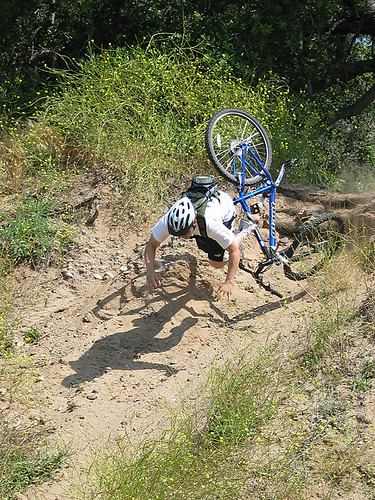
And then there was us - three egregious English Mountain Bikers with wild stories of how fast we had descended White's Level* and hitching up our trouser-legs to compare cuts and bruises. For where there were once mines and freight railways in the Afan Valley, there is now the Afan Forest Mountain bike centre, with 100km of purpose built, hair-raising single-track bike trails which draw mountain bikers from all over the country, alien lycra-clad beings in the valley communities. The barmaid came and took our order: The popular choice was three more pints of bitter.

We cycled 70 miles in three days, back-breaking climbs and tingling descents. In the evenings we cooked for ourselves and at lunchtimes we had vast and welcome portions of carbohydrate based meals at the Afan Mountain Bike centre. I punctured twice and broke a valve once We got soaked to the skin and covered from head to toe in mud. We had an excellent time.

We were there from Friday to Sunday and between us we probably spent £500 in Cymer. I wonder if that is enough to keep the village afloat.

*not quite this fast

11 May 2010

Ups and Downs

Well I, for one, welcome our new ConDem overlords.

Picture by Origamidon

But I am grumpy about finding myself older than the Prime Minister. Too soon, too soon.

(Did the Tories give away too much?)